Mars · Mars Express · Geology · Dunes · 5 min read
Metallic Waves on Ancient Mars
They look like metal. They are sand.
They look like metal. They are sand.
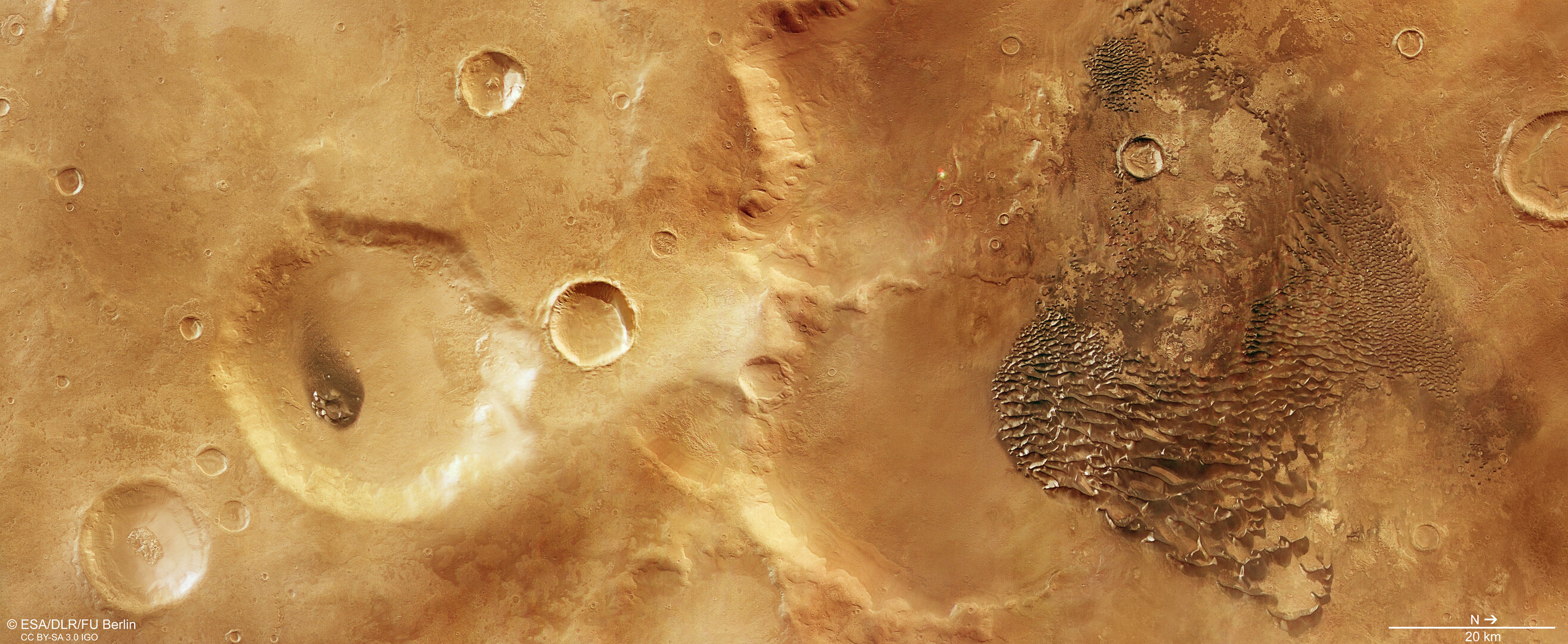
They look like metal. They are sand. Mars Express pointed HRSC at Kaiser Crater in Noachis Terra, one of the oldest pieces of Mars. Four billion years of impacts. The crater itself is about 180 km across and a couple of kilometers deep. The dark ripples on the floor can stand more than 100 m tall. Some sit alone. Others merge into a field that runs for kilometers.
The shine is frost
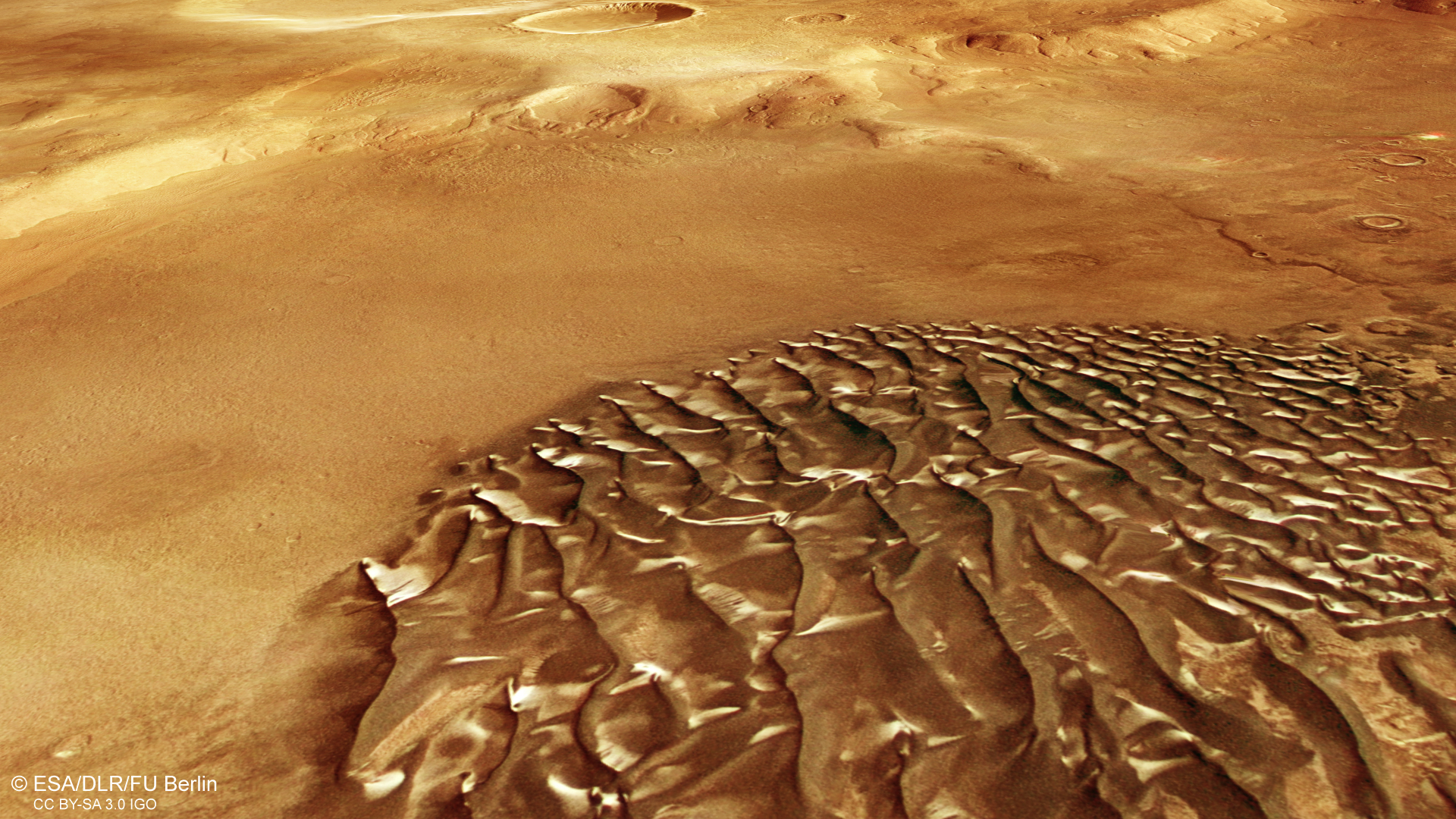
The shine is frost, not ore. ESA says the metallic look comes from bright frost on the south-facing slopes. The sand is basaltic: fine grains rich in pyroxene and olivine, volcanic minerals still being pushed around.
Two dune types in the same field
Two dune types in the same field. Barchans are the sickle ones, the most common dune on Mars, same shape as the Sahara and Namib. Transverse dunes are the longer parallel ridges. They can grow out of barchans once enough sand piles up. Both need wind from one direction. Here that wind is from the west (the top of the labeled frame; north is to the right).
The field is still moving
The field is still moving. This is not a fossil. It is weather.
Under the moving sand
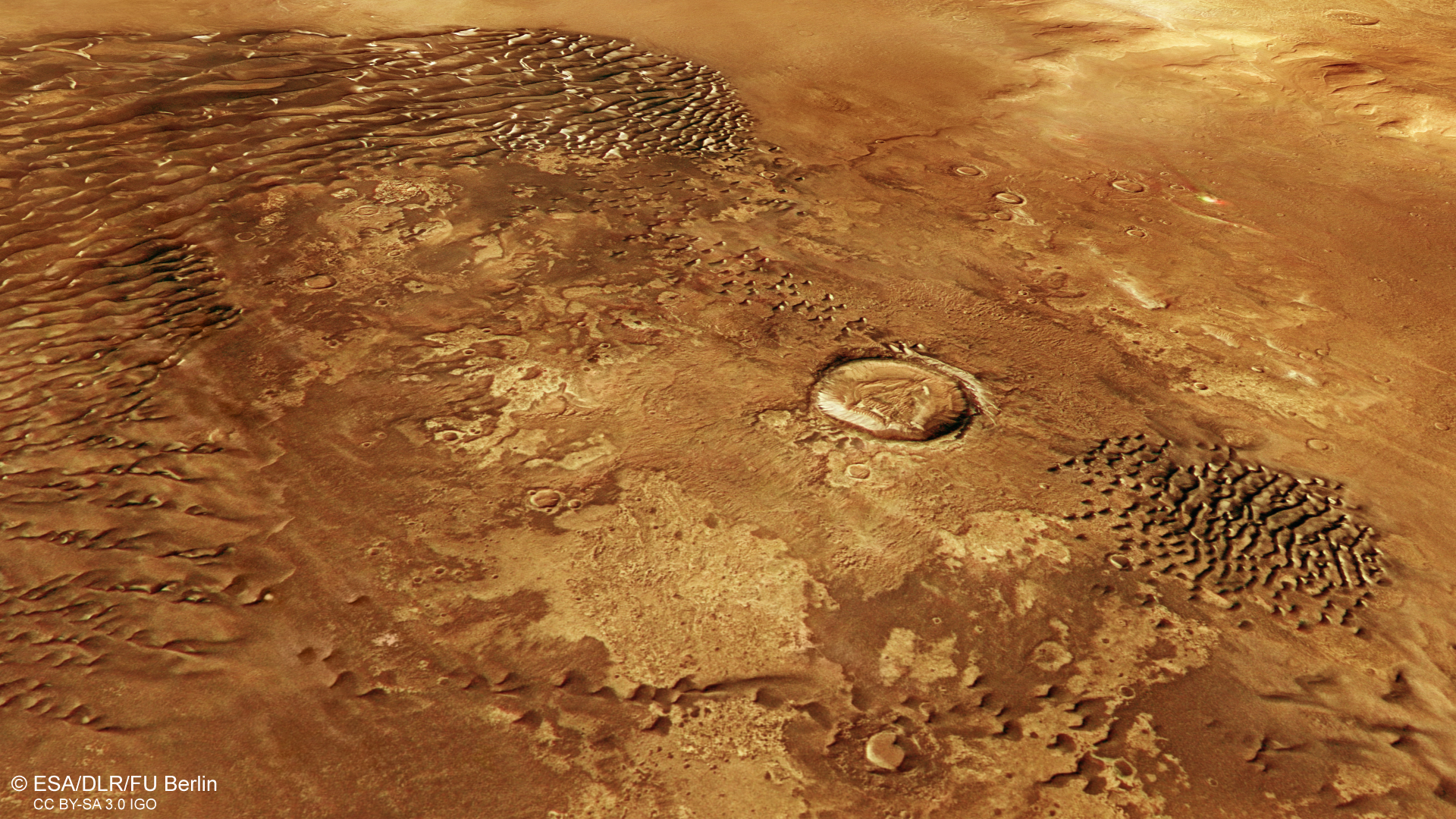
Under the moving sand is the older story. Wind has stripped the surface in places and exposed light-toned clay that likely formed in water. Gullies on the steeper crater walls are mostly dry landslides. ESA leaves the door open that some older ones came from melting ice or buried groundwater shifting the ground.
One camera, one orbit
Mars Express has been doing this since 2003. HRSC is still mapping the planet in color and stereo. This frame is one camera, one orbit, and you get wind, frost, volcanic sand, and a wetter past in the same crater.
- Instrument — HRSC / Mars Express
- Data — 5 October 2025, orbit 27461
- Scale — ~17 m/pixel
- Center — ~48°S / 19°E
- North — to the right on the labeled frame
- Release — 15 July 2026
Selected primary sources
ESA, “Metallic waves on ancient Mars,” 15 July 2026, https://www.esa.int/Science_Exploration/Space_Science/Mars_Express/Metallic_waves_on_ancient_Mars. Image page: https://www.esa.int/ESA_Multimedia/Images/2026/07/Mars_Express_spies_metallic_waves_in_Mars_s_ancient_highlands. HRSC / Mars Express, 5 October 2025, orbit 27461. Credit ESA/DLR/FU Berlin. License CC BY-SA 3.0 IGO. ESA is the source for Kaiser Crater in Noachis Terra, about 180 km across and a couple of kilometers deep, dark ripples that can stand more than 100 m, frost on south-facing slopes as the cause of the metallic look, basaltic sand rich in pyroxene and olivine, barchan and transverse dunes, wind from the west, light-toned clay that likely formed in water, and gullies that are mostly dry landslides with older ones possibly from melting ice or buried groundwater. This desk did not call the shine metal or ore. It did not invent a landing or a city.
Ask this paper
Grok answers from this essay only. Sign in so the call stays on your session — one question at a time.
Sign in to askNext
Starbase, Louisiana