Starship · Architecture · Crew · 11 min read
The Flight-Article Cabin
More than 600 cubic meters. Two airlocks at 13. Five tons moved between tanks, not between ships. A cabin being built is not a landing.
Two-thirds of a station is not a city
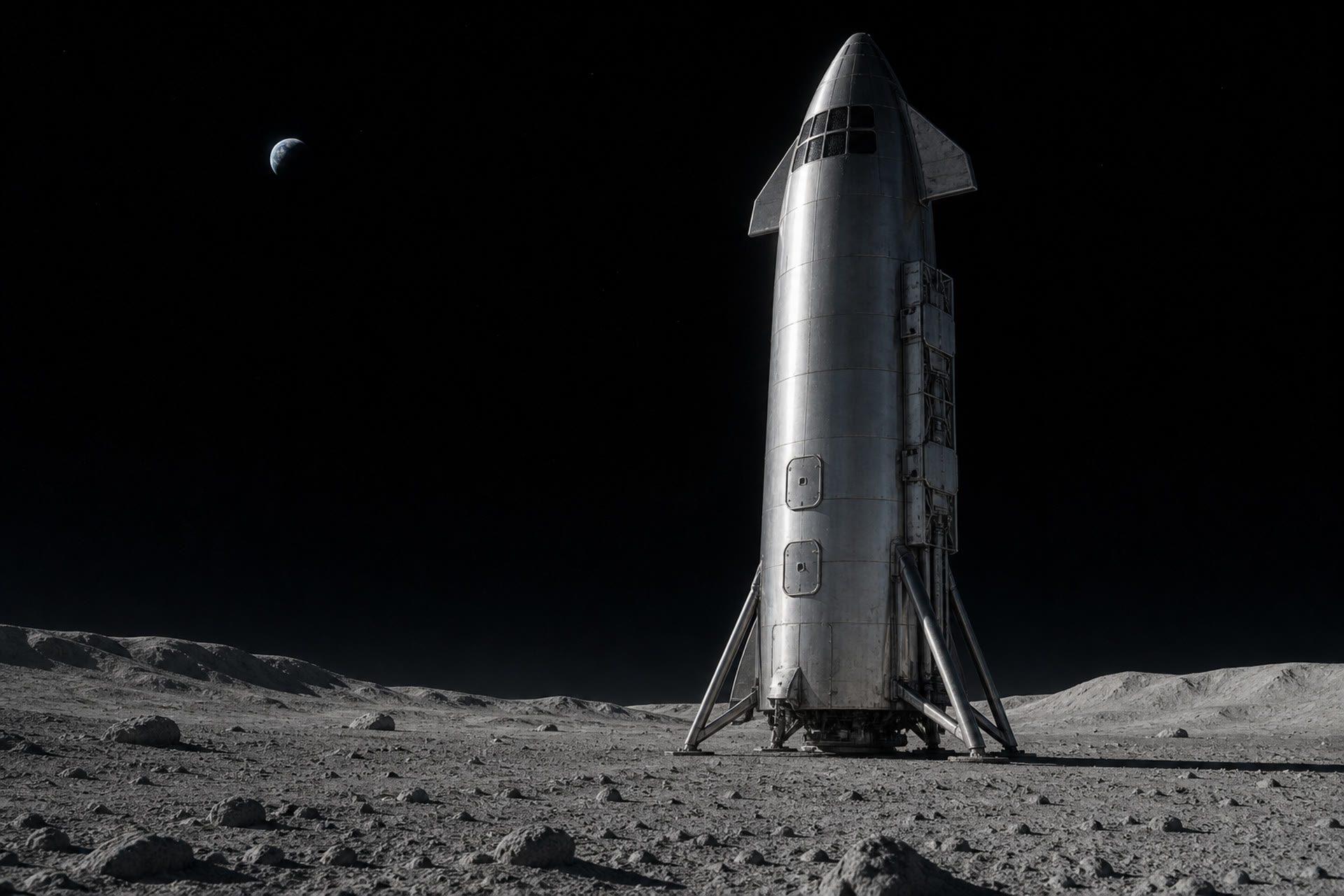
On 30 October 2025 SpaceX published the lander page. One Starship has more than 600 cubic meters of pressurized habitable volume — roughly two-thirds of the International Space Station — a cabin that can be scaled for large numbers of explorers, and dual airlocks for surface work. Each airlock is about 13 cubic meters, more than double the Apollo lander. Cargo variants are claimed at up to 100 metric tons directly to a surface: unpressurized rovers, pressurized rovers, nuclear reactors, lunar habitats. That is the volume sentence. It is not a crew manifest and it is not a Mars landing. NASA selected Starship in 2021 as the Artemis III lander and again for Artemis IV. The bid, SpaceX printed, had the highest technical and management ratings and was the lowest cost by a wide margin. A selection is not a bootprint. This desk will keep the cabin that size.
Two paths, one vehicle
SpaceX split the work. Path 1 is the core Starship system and the plants that feed it — production, test, launch sites — self-funded, more than 90 percent of system cost. Path 2 is the HLS-specific configuration, the modifications NASA’s landing requires. The contract is fixed-price. The company is paid after milestones close. Taxpayers, the page said, are not on the hook for SpaceX overruns. NASA gets insight on both paths, including flight data from missions the HLS contract did not buy. Both paths are necessary. High-rate production, launch, and test are what make a lander a cadence instead of a flag. Starship, SpaceX wrote, will enable sustainable lunar operations by being fully and rapidly reusable, cost-effective, and capable of high-frequency lunar missions with more than 100 tons of cargo. That is the architecture sentence. It is not a flown cargo tonne.
Five tons is not a tanker
As of that October page, the core campaign had produced multiple successful ascents of the world’s most powerful rocket; launch, return, catch, and reuse; the transfer of approximately five metric tons of cryogenic propellant between tanks while in space — a first-of-its-kind operation that provides data for future full-scale transfer; in-space Raptor relights; and multiple controlled reentries. More than three dozen Starships and 600 Raptor engines. More than 226,000 seconds on Raptor 2. More than 40,000 seconds on Raptor 3. Eleven ship-only flight tests and eleven integrated flights. Those counts are 30 October 2025. This desk will not pretend they are today’s stack. Five tons between tanks on one ship is the important sentence. It is not ship-to-ship. The V3 paper already named the four leeward drogues and the feed connections. The flyby paper already named the 2026 gate. Five tons is why the gate can be attempted. It is not the gate.
- Between tanks — ~5 t of cryogenic propellant, in space (30 Oct 2025)
- Not ship-to-ship — that demonstration is still the 2026 load
- Raptor 3 runtime — >40,000 s as of that page
- Production as of that page — >36 ships, 600 engines
- Plants — >5 million sq ft and five pads across Texas and Florida, planned
Forty-nine milestones, one cabin
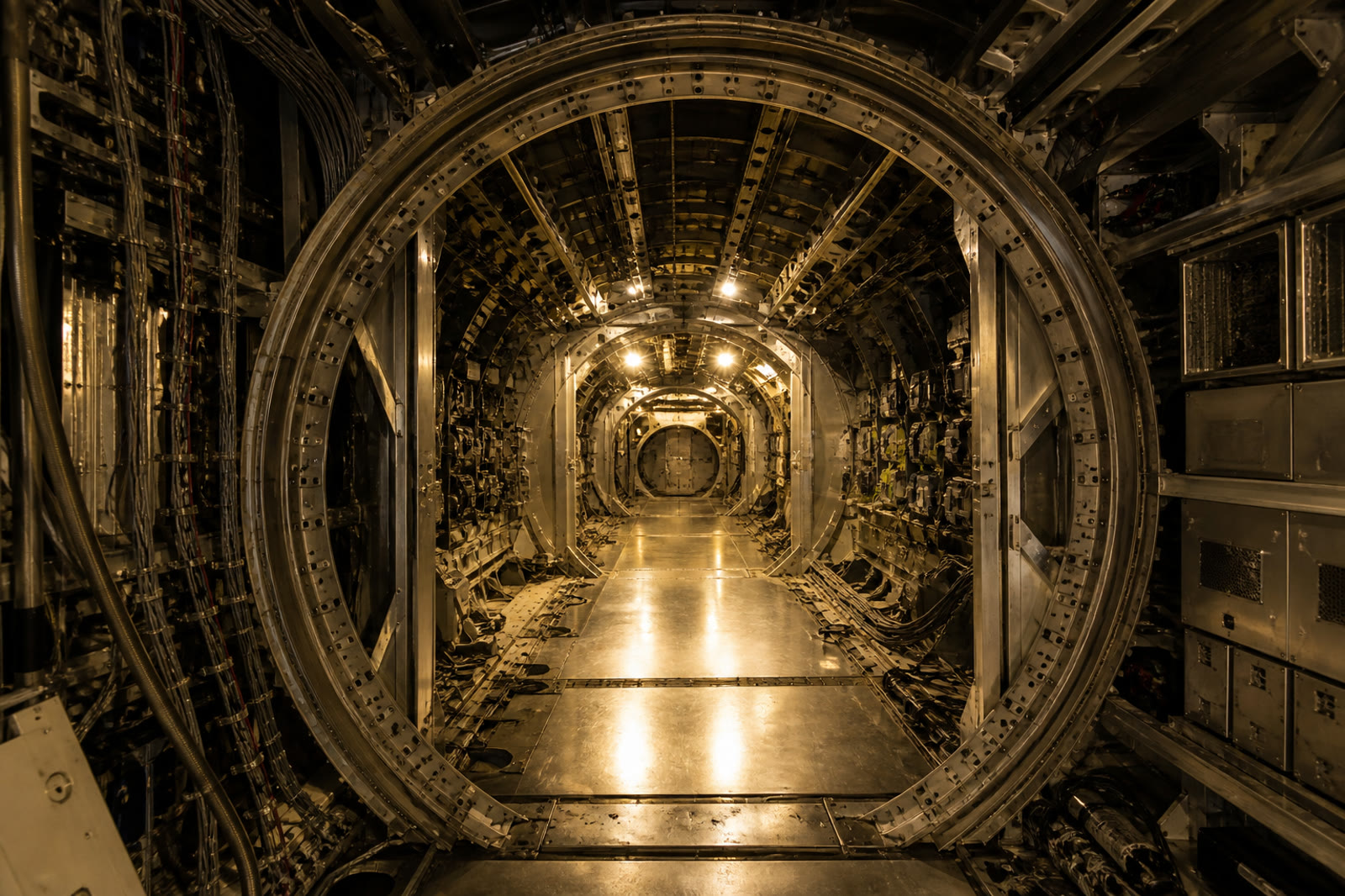
The HLS team had completed 49 milestones tied to subsystems, infrastructure, and operations. Money only on completed contractual milestones, most on time or ahead. The highlights SpaceX printed: a full-scale cabin module inhabited by multiple people to test oxygen and nitrogen injection, air distribution and sanitation, humidity and thermal control, plus cabin acoustics. Docking-adapter qualification of an androgynous system that will link Starship and Orion, based on Dragon 2, able to be active or passive. A full-scale landing-leg drop at flight energies onto simulated lunar regolith. A Raptor lunar-landing throttle profile. Micrometeoroid and debris tests of shielding, insulation, and windows. Landing software, sensors, and radar for a precise lunar site. A software-architecture review for fault detection, caution and warning, command and telemetry. Raptor cold starts, sea-level and vacuum, pre-chilled to simulate a long coast. An integrated lunar mission operations plan with NASA. A depot power-module demonstration. Ground-segment RF between a flight-equivalent station and a flight-equivalent vehicle. An elevator and airlock demonstration with Axiom using flight-representative pressurized EVA suits. A medical-system and telemedicine demonstration. A hardware-in-the-loop testbed for the propellant-transfer flight test. A completed milestone is not a landing. A drop test onto simulated dust is not a foot on the Moon.
- 49 HLS milestones completed as of 30 Oct 2025
- Cabin ECLSS — full-scale module, multiple people, O2/N2, humidity, thermal, acoustics
- Docking — androgynous adapter for Starship–Orion, Dragon 2 heritage
- Legs — full-scale drop onto simulated regolith at flight energy
- Raptor — lunar throttle profile; cold starts after a simulated coast
- Elevator + airlock — practiced with Axiom in flight-representative EVA suits
- Depot power module and HITL transfer testbed — demonstrated, not flown ship-to-ship
The cabin that has to wait
Many remaining HLS milestones are flight tests, including ship-to-ship propellant transfer. SpaceX had started fabricating a flight-article Starship HLS cabin: functional avionics and power, crew systems and mechanisms, ECLSS, cabin and crew communications, cabin thermal control. That article is for design maturity, integrated hardware testing, and realistic training. It is not a flown crew. The next major HLS flight milestones are a long-duration flight test and an in-space propellant-transfer flight test, both targeted for 2026, timing driven by how V3 flight tests progress. Sequence: a Starship from Starbase stays on orbit for propulsion, thermal, long-duration storage, and boil-off. A second Starship launches, rendezvous, and transfers. V3 ships come with docking ports and can be tankers with docking probes. The pad propellant connection has been updated for on-orbit transfer. Rendezvous uses DragonEye, with heritage from dozens of Dragon dockings at ISS, separately characterized for Starship. Experimental RF propellant-gauging sensors have been flying on recent tests to measure tanks in microgravity. On-orbit refill is what lets the page claim up to 100 tons to the lunar surface. Without it, the cargo sentence is a rendering. SpaceX also wrote that it is formally assessing a simplified mission architecture it believes is faster and safer as Artemis III requirements moved. Assessing is not selected. This desk will not invent the simplification.
The desk load
The 2026 gates have not moved. V3. Long duration. Ship-to-ship transfer. The flyby still comes home without a landing. Ice still sits under meters of dust. Return still wants about 2,400 tonnes of methane and oxygen cooked on Mars. Power still wants about 3.6 megawatts. Those loads live in The Last Meters of Dust and Powering Mars. This paper is the lander SpaceX printed on 30 October. Six hundred cubic meters. Two airlocks. Forty-nine closed milestones. A flight-article cabin in the shop. Five tons between tanks. The Moon is the nearer customer for the same transfer physics. Mars, on the published crew path, is still a flyby. A cabin is not a city.
Selected primary sources
SpaceX Updates, “To the Moon and Beyond,” 30 October 2025, https://www.spacex.com/updates/moon-and-beyond. SpaceX Updates, “Introducing Starship V3,” 12 May 2026, https://www.spacex.com/updates/starship-v3. SpaceX, “Starship,” https://www.spacex.com/vehicles/starship. NASA HLS docking-adapter and elevator notes linked from that October page. The 30 October 2025 desk is the source for 600 m³, dual ~13 m³ airlocks, 100 t cargo lander, >90% self-funded core path, 49 HLS milestones and the listed demonstrations, ~5 t between-tank transfer, Raptor runtimes, the flight-article cabin being fabricated, the 2026 long-duration and ship-to-ship tests driven by V3, DragonEye, RF gauging, Artemis III and IV selections, and a simplified architecture under formal assessment. SpaceX has not published a ship-to-ship transfer result or a lunar landing on this generation. This desk will not borrow one.
Ask this paper
Grok answers from this essay only. Sign in so the call stays on your session — one question at a time.
Sign in to askNext
Starbase, Louisiana