Starship · Architecture · Crew · 8 min read
The First Interplanetary Flyby
Two years outside the Earth-Moon system, a flyby of the Red Planet, and a return to Earth. Not a landing. A named commander is not a closed architecture.
A flyby is not a city
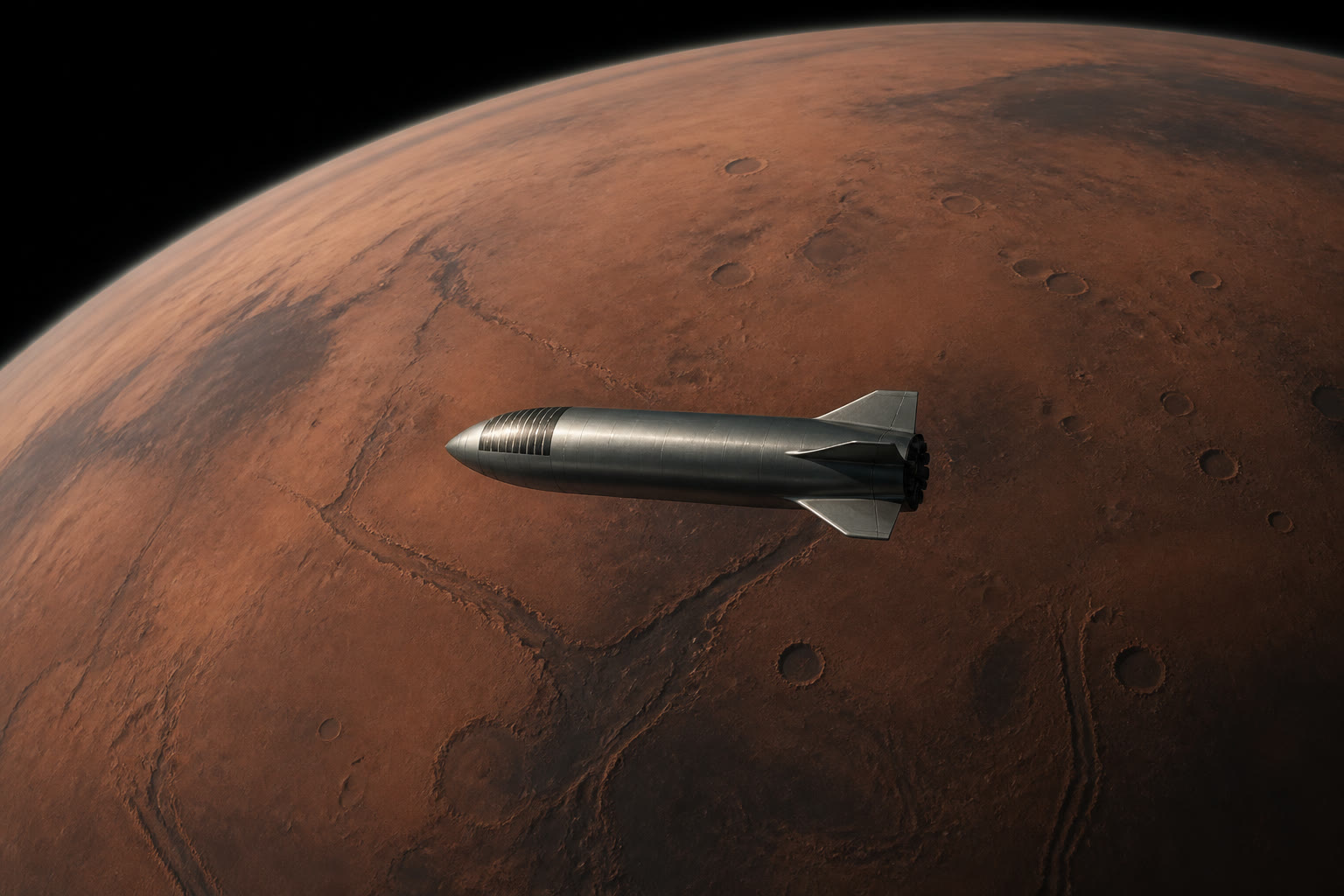
SpaceX put the sentence in block capitals: FIRST STARSHIP INTERPLANETARY HUMAN SPACEFLIGHT MISSION. Chun Wang, Mission Commander of Fram2 — the first human spaceflight over Earth’s poles — will fly aboard Starship’s first human spaceflight interplanetary missions to Mars. The two-year mission will explore outside the Earth-Moon system before flying by the Red Planet and returning to Earth. That is the announcement. This desk will keep it that size. This is a flyby. The ship does not land. The crew does not walk. The same first-party pages that named Chun also describe the city that is supposed to follow: a self-sufficient settlement of upwards of one million people, millions of tonnes of cargo, several thousand Starships, and more than ten launches a day to fill roughly twenty-six-month transfer windows. That is a different machine. A named commander is not a closed architecture. A pass by Mars is not a city. This desk will not staff a flyby with a million people, and it will not let a press sentence grow landing gear it does not have.
Two commercial crew missions
Starship, SpaceX printed, will expand access that Dragon already flew — to the Moon and Mars — with two upcoming commercial human spaceflight missions. Since May 2020 the company has flown 78 crewmembers from 20 countries across 20 Dragon missions, including seven commercial and private astronaut missions. That record is the flown baseline. Starship is the expansion. It is not, yet, the city. The first of the two is a week-long circumlunar fly-by. Chun will join Dennis and Akiko Tito on the first planned Starship commercial human spaceflight around the Moon, planned to fly within 200 km of the lunar surface, to advance Starship systems for deep-space, long-duration missions. The second is the two-year interplanetary path: leave the Earth-Moon system, fly by Mars, return to Earth. SpaceX has not published a launch year or a transfer window for either mission. This desk will not invent one. The published crew on the lunar week is three names. The published commander on the Mars flyby is one. Up to 100 people on long-duration interplanetary flights is a vehicle claim on the Starship page. It is not a manifest for this pass.
- Lunar fly-by — week-long, planned within 200 km of the surface; Dennis Tito, Akiko Tito, Chun Wang
- Mars flyby — two years; leave the Earth-Moon system; return to Earth; Chun Wang named
- Landing — not this path
- Launch year — unpublished for either flyby
- Dragon flown — 78 crewmembers, 20 countries, 20 missions since May 2020
- Seven of those — commercial / private astronaut missions
- Vehicle claim — up to 100 people on long-duration interplanetary flights; not a flyby manifest
What has to close before anyone leaves
Nobody leaves until the 2026 tests close. The next major flight milestones SpaceX has printed for the Human Landing System are a long-duration flight test and an in-space propellant transfer flight test, both targeted for 2026, with timing driven by Starship V3 flight tests. On-orbit refilling is the same gate that lets SpaceX print up to 100 tons directly to the lunar surface. Without rapid cryogenic transfer in orbit, Starship is a heavy-lift vehicle, not a deep-space ship. That sentence is already this desk’s 2026 Refueling Gatekeeper load. It has not gotten lighter because a commander now has a name. Starship and Super Heavy are designed fully reusable, with more than 100 metric tonnes to orbit in reusable configuration. That is the Earth-orbit number. It is not a Mars-arrival number, and it is not a reason to skip the transfer demonstration. A long-duration test is the other half of the same gate. A week around the Moon is a systems rehearsal. Two years outside the Earth-Moon system is the real life-support load. Neither commercial flight is a substitute for watching cryogenic methane and oxygen move between ships in orbit, at the rate a departing stack actually needs.
- Starship V3 flight tests — the clock that drives the 2026 milestones
- Long-duration flight test — targeted 2026
- In-space propellant transfer flight test — targeted 2026
- On-orbit refill — up to 100 t directly to the lunar surface
- Reusable to orbit — more than 100 metric tonnes
- The gate — without rapid cryogenic transfer, Starship stays a heavy-lift vehicle
The tanker is the interplanetary stage
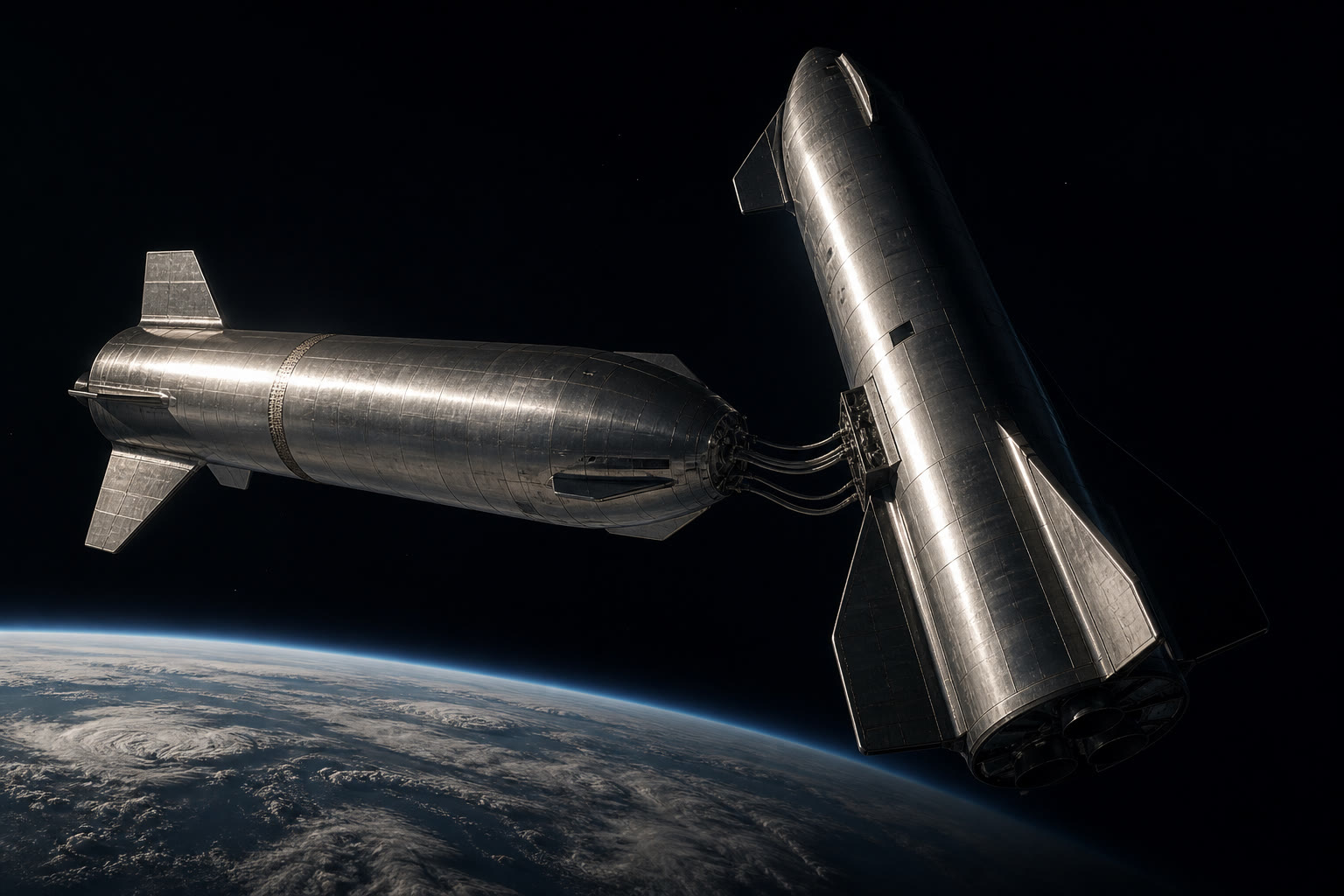
The tanker is the interplanetary stage. SpaceX’s architecture is not a single ship lifting off full and arriving full. Tankers refill Starship in low Earth orbit before the stack departs for Mars. That refill is what lets the company claim several hundred tonnes of cargo all the way to Mars, and what lets HLS claim up to 100 tons directly to the lunar surface. The lunar number is the nearer proof: same transfer physics, shorter loop, a customer already on the page. Until that transfer has been flown, the cargo sentence is a rendering. SpaceX also prints Starship cargo flights to the Martian surface no earlier than 2028 at $100 million per metric ton. That is a sales line, not a flown fact. This desk will keep the label on it. NET 2028 has not landed a tonne. $100 million per ton has not been paid for a tonne. The reusable stack that puts more than 100 tonnes in orbit is a real vehicle class. The tanker that turns that class into a deep-space ship is the 2026 demonstration. Mixing the two is how a heavy-lift vehicle becomes, on a homepage, a city.
Heatshield and time
7.5 km/s is a landing-ship number. SpaceX’s Mars architecture enters the atmosphere at 7.5 kilometers per second and uses aerodynamic deceleration. The heatshield is designed for multiple entries. Mars entry carries higher atomic oxygen than Earth entry; SpaceX has tested heatshield materials in a simulated Mars atmosphere. None of that is a flyby profile. A flyby does not take the 7.5 km/s hit on the way in. It still has to come home. Coming home means a heatshield that has already done Earth work, or will, after two years in deep space — and a ship designed, from the beginning, for more than one entry. Two years is the other load. The published mission leaves the Earth-Moon system, passes Mars, and returns to Earth. That is not a Dragon weekend and it is not a lunar week. It is a closed-loop life-support problem for a duration SpaceX has now written down and a crew size it has not. This desk will not invent a radiation dose, a consumables mass, or a spare-parts list. It will say the sentence that is actually on the page: two years, a flyby, a return. The heatshield work and the life-support work are why a named commander is still not a closed architecture.
The desk load
The city loads have not moved. Ice still sits under meters of abrasive dust. Return still wants about 2,400 tonnes of methane and oxygen cooked on the surface. Power still wants about 3.6 megawatts of baseload that solar cannot hold through a storm. Those numbers live in The Last Meters of Dust and Powering Mars. They remain unsolved. They are also not this paper. This paper is the crew path SpaceX actually published. Starship was designed from the beginning to run on liquid methane and oxygen that can be mined and refined on Mars. That sentence is why the city is even a sentence. It is not why this flyby flies. The flyby comes home on propellant it took from Earth, after tankers filled it in low Earth orbit. No ISRU plant opens. No ice is mined. No second ship is filled for a return climb off the surface. Mixing the flyby with the city is how a two-year pass grows a million people. This desk will keep the two machines apart. The work now is the 2026 gate — V3, long-duration flight, cryogenic transfer — and then a week inside 200 km of the Moon. Mars, on this path, is a flyby that comes home.
Selected primary sources
SpaceX, “Mission: Mars,” https://www.spacex.com/humanspaceflight/mars. SpaceX, “Starship,” https://www.spacex.com/vehicles/starship. SpaceX Updates, Starship V3, https://www.spacex.com/updates/starship-v3. SpaceX Updates, starship-moon-announcement, https://www.spacex.com/updates/starship-moon-announcement. The May 2026 Updates desk is the source for Chun Wang, the two-year Mars flyby that returns to Earth, the week-long circumlunar pass planned within 200 km of the Moon, the Dragon record of 78 crewmembers from 20 countries across 20 missions since May 2020, and the HLS long-duration and in-space propellant transfer tests targeted for 2026. Mission: Mars and the Starship vehicle page are the source for the city scale, tanker refill in low Earth orbit, several hundred tonnes of cargo to Mars, more than 100 metric tonnes to orbit reusable, up to 100 people on long-duration interplanetary flights, methane and oxygen that can be mined on Mars, 7.5 km/s entry, and cargo to the surface NET 2028 at $100 million per metric ton. SpaceX has not published a launch year for either flyby. This desk will not borrow one.
Ask this paper
Grok answers from this essay only. Sign in so the call stays on your session — one question at a time.
Sign in to askNext
Mars’s Subsurface Sanctuary